

Canada and Saudi Arabia: A New Chapter in Bilateral Relations
By : Dr. Mohammad SAFAR
Middle East Specialist -
Head of Minorities Studies Center, Oakville, Canada
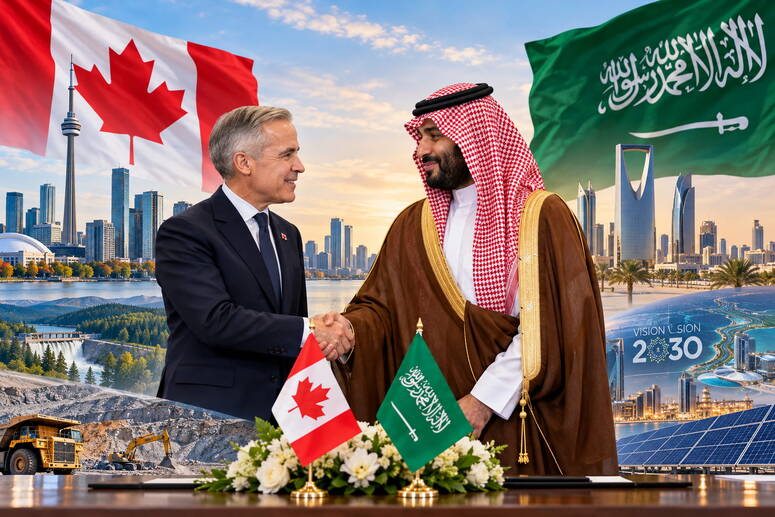
Amid profound shifts in the global political and economic landscape, relations between Canada and Saudi Arabia have entered a defining new phase. More than a decade after former Canadian Prime Minister Stephen Harper visited the Kingdom in 2014 and concluded what was then Canada's largest-ever defence export agreement—a deal worth approximately US$15 billion—Prime Minister Mark Carney traveled to Saudi Arabia in July 2026 leading a high-level political and business delegation.
The visit resulted in the signing of a series of economic agreements and strategic partnerships in energy, artificial intelligence, mining, and other key sectors, with announced projects exceeding US$1 billion. The agreements signal not only the restoration of bilateral relations but also a shared commitment to expanding long-term economic cooperation.
Why Canada and Saudi Arabia?
Canada and Saudi Arabia share several strategic advantages. Both are members of the G20, rank among the world's leading producers of oil and natural gas, and possess some of the largest natural resource reserves globally. The estimated value of each country's natural resources approaches US$35 trillion.
Canada's economy remains the larger of the two, with a gross domestic product exceeding US$2.3 trillion, nearly double Saudi Arabia's GDP of approximately US$1.3 trillion. Canada ranks as the world's ninth-largest economy by nominal GDP, while Saudi Arabia is eighteenth but holds some of the world's largest proven energy reserves.
Despite these similarities, the two economies differ significantly in structure. Canada's economy is highly diversified, relying not only on energy and natural resources such as timber but also on manufacturing, financial services, automotive production, and industrial machinery. Manufacturing and related industries account for roughly 40 percent of Canada's economic output.
Saudi Arabia, by contrast, has accelerated its economic transformation under Vision 2030, shifting away from its traditional dependence on oil. Last year, the Kingdom's non-oil economy contributed approximately 50 percent of GDP, generating more than US$450 billion in economic activity. Nevertheless, oil continues to account for nearly 90 percent of Saudi exports.
A Relationship Built Over Decades
Long before the diplomatic crisis of 2018, Canada and Saudi Arabia enjoyed decades of steady political, economic, and educational cooperation.
In 2015, bilateral trade was balanced, with imports and exports between the two countries reaching approximately US$1.5 billion in each direction. Between 2012 and 2018, Saudi Arabia was Canada's second-largest export market in the Middle East.
The partnership extended beyond trade. During the Gulf War, Canadian forces participated alongside the international coalition to liberate Kuwait, while Canada established a field hospital in Qaisumah to provide medical care for coalition personnel.
Educational ties also became a cornerstone of the relationship. Saudi Arabia opened its first cultural office in Canada in 1978 to oversee Saudi students studying abroad. By 2007, approximately 15,000 Saudi students were enrolled in Canadian institutions, alongside around 500 Saudi medical residents and specialists working in Canadian healthcare facilities.
By 2015, the number of Saudi students had risen to approximately 16,000, accompanied by nearly 1,000 medical trainees. Saudi students represented about 3 percent of all international students in Canada. Their contribution was also economically significant. International students collectively generate more than C$37 billion annually for the Canadian economy through tuition, housing, consumer spending, and related services, supporting more than 360,000 jobs nationwide.
From Diplomatic Rift to Reconciliation
Relations deteriorated sharply in August 2018 after Canada's foreign minister publicly called for the immediate release of Saudi activist Samar Badawi.
Saudi Arabia rejected the statement as interference in its domestic affairs. Then-Foreign Minister Adel Al-Jubeir stated that while countries are free to express their opinions, no foreign government has the right to dictate Saudi domestic policy.
The dispute quickly escalated into one of the most serious diplomatic crises in the history of bilateral relations. Saudi Arabia expelled the Canadian ambassador from Riyadh and recalled its own ambassador from Ottawa. The Kingdom suspended scholarship programs for approximately 16,000 Saudi students, suspended medical cooperation, liquidated all Saudi investments and shares, suspended Saudi Arabian Airlines flights to Canada, and stopped importing Canadian products and agricultural goods worth nearly US$1.5 billion annually. Canadian barley alone accounted for approximately 7 percent of Canada's exports to Saudi Arabia.
The diplomatic dispute also reignited domestic debate in Canada over the multibillion-dollar defence contract signed under Prime Minister Stephen Harper. Although human rights organizations urged the Trudeau government to cancel the agreement, then-PM Justin Trudeau stated that Canada would honour its contractual commitments.
The breakthrough came several years later. During the Asia-Pacific Economic Cooperation (APEC) summit in Bangkok in November 2022, Prime Minister Trudeau met Crown Prince Mohammed bin Salman, paving the way for reconciliation. Saudi Arabia subsequently restored diplomatic relations, allowing ambassadors and Saudi students to return. In 2024, the two countries further strengthened ties when the chamber of commerce announced the resumption of economic cooperation and the revival of the Canada–Saudi Joint Business Council.
Why Has the Relationship Rebounded So Strongly?
Several regional, international, and domestic developments have driven the rapid revival of Canada-Saudi relations.
Regionally, Canada's increasingly difficult trade relationship with the United States—marked by tariff disputes, changes to long-standing trade privileges, and renewed protectionist policies under President Donald Trump—has encouraged Ottawa to diversify its economic partnerships beyond its overwhelming dependence on the American market.
While Canada has expanded trade with Europe and China, demand from those markets remains concentrated largely on Canadian raw materials such as minerals and timber. Saudi Arabia, however, presents a fundamentally different opportunity.
With its strong financial position, ambitious development agenda, and rapidly growing economy, the Kingdom requires Canadian expertise in renewable and nuclear energy, mining, artificial intelligence, advanced engineering, and technical services. Canadian companies have maintained a presence in Saudi Arabia since the 1960s, positioning them to participate in the Kingdom's next phase of economic transformation.
Saudi Arabia's Vision 2030 includes a series of mega-projects, including preparations for the FIFA World Cup, Expo, the construction of new cities, airports, highways, railway networks, energy infrastructure, oil and gas pipelines, and ports. These are sectors in which Canadian firms possess decades of internationally recognized expertise, while Saudi Arabia has both the financial resources and the strategic need to accelerate development, particularly in the aftermath of recent regional security challenges.
Domestic priorities have also evolved in both countries. While Saudi Arabia continues implementing Vision 2030, Canada has likewise turned inward to strengthen its own economic resilience. The Carney government has announced a new generation of strategic "gigaprojects" valued at nearly US$500 billion, covering energy, hospitals, housing, transportation, nuclear power, oil pipelines, ports, and defence industries.
These projects are expected to attract significant international investment, creating substantial opportunities for Saudi companies and investors. Saudi Arabia's Public Investment Fund (PIF), with assets estimated at approximately US$1.15 trillion, is well positioned to become a major investment partner in Canada's expanding infrastructure and industrial sectors.
Looking Ahead
Canada's renewed strategy of expanding exports, attracting foreign investment, and strengthening partnerships beyond North America is likely to make its economy more resilient while reducing its dependence on the U.S. market.
Whether relations with Washington eventually stabilize or remain strained, Canada's broader diversification strategy appears set to continue. That strategy aligns closely with Saudi Arabia's own efforts to diversify both its economy and its international partnerships.
Although the United States will remain Saudi Arabia's closest strategic ally and its largest source of commercial opportunities due to the scale of the American economy, the Kingdom is equally committed to broadening its network of economic partners.
Against this backdrop, Canada and Saudi Arabia possess highly complementary strengths. Their renewed relationship is built not only on shared economic interests but also on the recognition that a more diversified network of global partnerships will be essential to navigating an increasingly uncertain international economy.
Middle East Specialist -
Head of Minorities Studies Center, Oakville, Canada
Amid profound shifts in the global political and economic landscape, relations between Canada and Saudi Arabia have entered a defining new phase. More than a decade after former Canadian Prime Minister Stephen Harper visited the Kingdom in 2014 and concluded what was then Canada's largest-ever defence export agreement—a deal worth approximately US$15 billion—Prime Minister Mark Carney traveled to Saudi Arabia in July 2026 leading a high-level political and business delegation.
The visit resulted in the signing of a series of economic agreements and strategic partnerships in energy, artificial intelligence, mining, and other key sectors, with announced projects exceeding US$1 billion. The agreements signal not only the restoration of bilateral relations but also a shared commitment to expanding long-term economic cooperation.
Why Canada and Saudi Arabia?
Canada and Saudi Arabia share several strategic advantages. Both are members of the G20, rank among the world's leading producers of oil and natural gas, and possess some of the largest natural resource reserves globally. The estimated value of each country's natural resources approaches US$35 trillion.Canada's economy remains the larger of the two, with a gross domestic product exceeding US$2.3 trillion, nearly double Saudi Arabia's GDP of approximately US$1.3 trillion. Canada ranks as the world's ninth-largest economy by nominal GDP, while Saudi Arabia is eighteenth but holds some of the world's largest proven energy reserves.
Despite these similarities, the two economies differ significantly in structure. Canada's economy is highly diversified, relying not only on energy and natural resources such as timber but also on manufacturing, financial services, automotive production, and industrial machinery. Manufacturing and related industries account for roughly 40 percent of Canada's economic output.
Saudi Arabia, by contrast, has accelerated its economic transformation under Vision 2030, shifting away from its traditional dependence on oil. Last year, the Kingdom's non-oil economy contributed approximately 50 percent of GDP, generating more than US$450 billion in economic activity. Nevertheless, oil continues to account for nearly 90 percent of Saudi exports.
A Relationship Built Over Decades
Long before the diplomatic crisis of 2018, Canada and Saudi Arabia enjoyed decades of steady political, economic, and educational cooperation.In 2015, bilateral trade was balanced, with imports and exports between the two countries reaching approximately US$1.5 billion in each direction. Between 2012 and 2018, Saudi Arabia was Canada's second-largest export market in the Middle East.
The partnership extended beyond trade. During the Gulf War, Canadian forces participated alongside the international coalition to liberate Kuwait, while Canada established a field hospital in Qaisumah to provide medical care for coalition personnel.
Educational ties also became a cornerstone of the relationship. Saudi Arabia opened its first cultural office in Canada in 1978 to oversee Saudi students studying abroad. By 2007, approximately 15,000 Saudi students were enrolled in Canadian institutions, alongside around 500 Saudi medical residents and specialists working in Canadian healthcare facilities.
By 2015, the number of Saudi students had risen to approximately 16,000, accompanied by nearly 1,000 medical trainees. Saudi students represented about 3 percent of all international students in Canada. Their contribution was also economically significant. International students collectively generate more than C$37 billion annually for the Canadian economy through tuition, housing, consumer spending, and related services, supporting more than 360,000 jobs nationwide.
From Diplomatic Rift to Reconciliation
Relations deteriorated sharply in August 2018 after Canada's foreign minister publicly called for the immediate release of Saudi activist Samar Badawi.Saudi Arabia rejected the statement as interference in its domestic affairs. Then-Foreign Minister Adel Al-Jubeir stated that while countries are free to express their opinions, no foreign government has the right to dictate Saudi domestic policy.
The dispute quickly escalated into one of the most serious diplomatic crises in the history of bilateral relations. Saudi Arabia expelled the Canadian ambassador from Riyadh and recalled its own ambassador from Ottawa. The Kingdom suspended scholarship programs for approximately 16,000 Saudi students, suspended medical cooperation, liquidated all Saudi investments and shares, suspended Saudi Arabian Airlines flights to Canada, and stopped importing Canadian products and agricultural goods worth nearly US$1.5 billion annually. Canadian barley alone accounted for approximately 7 percent of Canada's exports to Saudi Arabia.
The diplomatic dispute also reignited domestic debate in Canada over the multibillion-dollar defence contract signed under Prime Minister Stephen Harper. Although human rights organizations urged the Trudeau government to cancel the agreement, then-PM Justin Trudeau stated that Canada would honour its contractual commitments.
The breakthrough came several years later. During the Asia-Pacific Economic Cooperation (APEC) summit in Bangkok in November 2022, Prime Minister Trudeau met Crown Prince Mohammed bin Salman, paving the way for reconciliation. Saudi Arabia subsequently restored diplomatic relations, allowing ambassadors and Saudi students to return. In 2024, the two countries further strengthened ties when the chamber of commerce announced the resumption of economic cooperation and the revival of the Canada–Saudi Joint Business Council.
Why Has the Relationship Rebounded So Strongly?
Several regional, international, and domestic developments have driven the rapid revival of Canada-Saudi relations.Regionally, Canada's increasingly difficult trade relationship with the United States—marked by tariff disputes, changes to long-standing trade privileges, and renewed protectionist policies under President Donald Trump—has encouraged Ottawa to diversify its economic partnerships beyond its overwhelming dependence on the American market.
While Canada has expanded trade with Europe and China, demand from those markets remains concentrated largely on Canadian raw materials such as minerals and timber. Saudi Arabia, however, presents a fundamentally different opportunity.
With its strong financial position, ambitious development agenda, and rapidly growing economy, the Kingdom requires Canadian expertise in renewable and nuclear energy, mining, artificial intelligence, advanced engineering, and technical services. Canadian companies have maintained a presence in Saudi Arabia since the 1960s, positioning them to participate in the Kingdom's next phase of economic transformation.
Saudi Arabia's Vision 2030 includes a series of mega-projects, including preparations for the FIFA World Cup, Expo, the construction of new cities, airports, highways, railway networks, energy infrastructure, oil and gas pipelines, and ports. These are sectors in which Canadian firms possess decades of internationally recognized expertise, while Saudi Arabia has both the financial resources and the strategic need to accelerate development, particularly in the aftermath of recent regional security challenges.
Domestic priorities have also evolved in both countries. While Saudi Arabia continues implementing Vision 2030, Canada has likewise turned inward to strengthen its own economic resilience. The Carney government has announced a new generation of strategic "gigaprojects" valued at nearly US$500 billion, covering energy, hospitals, housing, transportation, nuclear power, oil pipelines, ports, and defence industries.
These projects are expected to attract significant international investment, creating substantial opportunities for Saudi companies and investors. Saudi Arabia's Public Investment Fund (PIF), with assets estimated at approximately US$1.15 trillion, is well positioned to become a major investment partner in Canada's expanding infrastructure and industrial sectors.
Looking Ahead
Canada's renewed strategy of expanding exports, attracting foreign investment, and strengthening partnerships beyond North America is likely to make its economy more resilient while reducing its dependence on the U.S. market.Whether relations with Washington eventually stabilize or remain strained, Canada's broader diversification strategy appears set to continue. That strategy aligns closely with Saudi Arabia's own efforts to diversify both its economy and its international partnerships.
Although the United States will remain Saudi Arabia's closest strategic ally and its largest source of commercial opportunities due to the scale of the American economy, the Kingdom is equally committed to broadening its network of economic partners.
Against this backdrop, Canada and Saudi Arabia possess highly complementary strengths. Their renewed relationship is built not only on shared economic interests but also on the recognition that a more diversified network of global partnerships will be essential to navigating an increasingly uncertain international economy.


 21°

 17°













Comments
0 de 0 commentaires pour l'article 338431